Issue 008

What you pay. What you sign. What you share.

France focus: the 2027 budget, electronic invoicing and protecting minors around AI.

12 min readSources and limitations identified in each analysis
SPECIAL EDITION FRANCE

The essentials, without losing the nuance

In 90 seconds

  1. 01

    Prepare

    Preparing for the budget means making your assumptions testable, not predicting the vote.
  2. 02

    Receive

    Your issuing deadline does not remove the need to check receipt now.
  3. 03

    Protect

    Technology for young people should help them grow, not make leaving harder.

LexiEditorial companion · articles and sources

Netlify AI Gateway · grounded in this issue

Question the issue. Not your case.

The companion explains only the Top 3, the radar and their checked sources. It refuses to invent and never replaces legal advice tailored to your situation.

Do not share personal or confidential information. The question goes through Netlify AI Gateway and is not added to your profile.

Write at least five characters or choose a suggested question.

The Wednesday letter · Law, technology, decisions

Law before the noise.

A wealth-planning decision. An invoice changing channels. A conversation between a child and a machine. Three situations in France that call for looking beyond announcements.

This issue separates proposals from applicable rules and suggests practical checks. It promises neither tax savings nor automatic safety.

Research closed on 13 October 2026. Editorial selection, not a ranking of most-viewed topics.

Editorial transparency

A selection explained, never proclaimed.

These three files are an editorial choice based on their legal timeliness and direct connection with Law Right’s practice. No worldwide ranking or audience volume is claimed.

Sources consulted on 13 October 2026; proposals and timetables may change.
  1. 1

    Frame

    Identify the legal question and the date that truly matters.

  2. 2

    Cross-check

    Prioritise official texts and test useful commentary against them.

  3. 3

    Translate

    Connect the rule to a concrete decision for the reader.

  4. 4

    Trace

    Preserve the sources, limits and update date.

Prepare

France’s 2027 budget: your next decision deserves more than an announcement

Gifts, retirement and business transfers: separate applicable law from scenarios still under discussion.

Areas of lawFrench taxationWealth planning
Keywords#2027 Finance Bill#proposal#gift#decision

Case statusSources consulted on 13 October 2026; proposals and timetables may change.

Original conceptual illustration prepared with AI assistance; no real event depicted.
Image and licence. Original conceptual illustration prepared with AI assistance; no real event depicted.

01

An identified bill, not an enacted Finance Act

France’s Finance Bill for 2027 was tabled in the National Assembly on 1 October 2026 as bill 3210. Debate on the revenue provisions is announced from 13 October. This is a bill under discussion, not an enacted Finance Act. [1,3]

Its contents include income-tax bands, retirement pensions, gifts, contribution-and-sale arrangements and life insurance. These headings do not establish the effect on your circumstances. Each measure requires examination of its conditions and temporal application. [2]

02

The version and date matter as much as the amount

A scenario can help prepare a decision. It becomes misleading when its “assumption” label disappears. Ask whether a calculation uses the original bill, an amendment, a parliamentary stage or the final enacted text. Keep the version and date consulted.

Before a significant transaction, have the taxable event and any transitional rules checked. Assuming an announcement already applies is as unwise as claiming a future law could never affect a situation begun earlier. This article calculates no individual tax liability.

03

Separate your actual file from reform assumptions

  1. Gather signed instruments, supporting records, deadlines and objectives that exist independently of the budget. Keep reform scenarios separately, together with their conditions.
  2. Request an official link and the text version for every numerical assumption. An isolated screenshot will not let you reconstruct the reasoning when the debate changes.
  3. Before signing, ask: “Would this still be a good decision if the reform changed tomorrow?” If not, have that dependency assessed before a difficult-to-reverse commitment.
FRANCE · DECISIONS THAT MATTER · 01

An announcement is not enough.

An announcement expresses an intention, not an established obligation.

Explanatory diagram: no live parliamentary tracking, security measurement or individual legal conclusion.
→

Preparing for the budget means making your assumptions testable, not predicting the vote.
Sources and verificationOpen the sources +
Receive

Electronic invoicing in France: waiting until 2027 may already leave you behind

Receiving and issuing invoices do not necessarily share a deadline. Small businesses should check that distinction now.

Areas of lawFrench taxationContract law
Keywords#electronic invoicing#receipt#SMEs#approved platform

Case statusSources consulted on 13 October 2026; proposals and timetables may change.

Original conceptual illustration prepared with AI assistance; no real event depicted.
Image and licence. Original conceptual illustration prepared with AI assistance; no real event depicted.

01

Two deadlines, not a general exemption

France’s tax authority distinguishes two stages in the general timetable. Since 1 September 2026, businesses within scope must be able to receive electronic invoices when their suppliers are required to issue them. Large businesses and intermediate-sized enterprises enter the issuing obligation on that date; SMEs and micro-enterprises follow on 1 September 2027, except where they are members of a single taxable person under Article 256 C of the French Tax Code (a VAT group), to which that deferral does not apply. The timetable must be read together with the reform’s scope, not as a duty covering every commercial document. [1,3]

The first check is practical: who receives the business’s invoices, through which service, and who checks their arrival? A folder named “invoices” in an email account does not prove that the required process works.

02

A PDF and a regulated transmission process are not the same

For transactions within electronic-invoicing scope, the tax authority describes structured data transmitted through an approved platform. An ordinary PDF emailed to a customer is insufficient. A hybrid format can combine a readable representation and structured data: the filename extension alone therefore does not settle the issue. [2]

Invoices sent to customers must also be distinguished from data reported to the administration. Transactions with individuals or foreign operators may fall under another component, e-reporting. Payment data follows its own logic. Classify transactions, possible exclusions and VAT treatment before identifying a specific duty. [2]

Changing software does not solve everything. Before choosing a provider, clarify service scope, access rights, data exports and the procedure for rejected invoices. These contractual and practical questions are not a promise of automatic compliance.

03

The useful test: follow an invoice from end to end

  1. Take a representative example without unnecessarily disclosing real data. Identify the customer type, transaction and corresponding duties. Then check receiving and issuing dates separately.
  2. Ask the software provider or adviser to demonstrate receipt, consultation, error handling and data retrieval. Name a responsible person and a substitute. Do not rely solely on a “compatible” marketing statement.
  3. Keep the provider’s response and test date. Check the official platform list and service conditions before committing. A process you understand is better evidence of preparation than a subscription alone.
FRANCE · DECISIONS THAT MATTER · 02

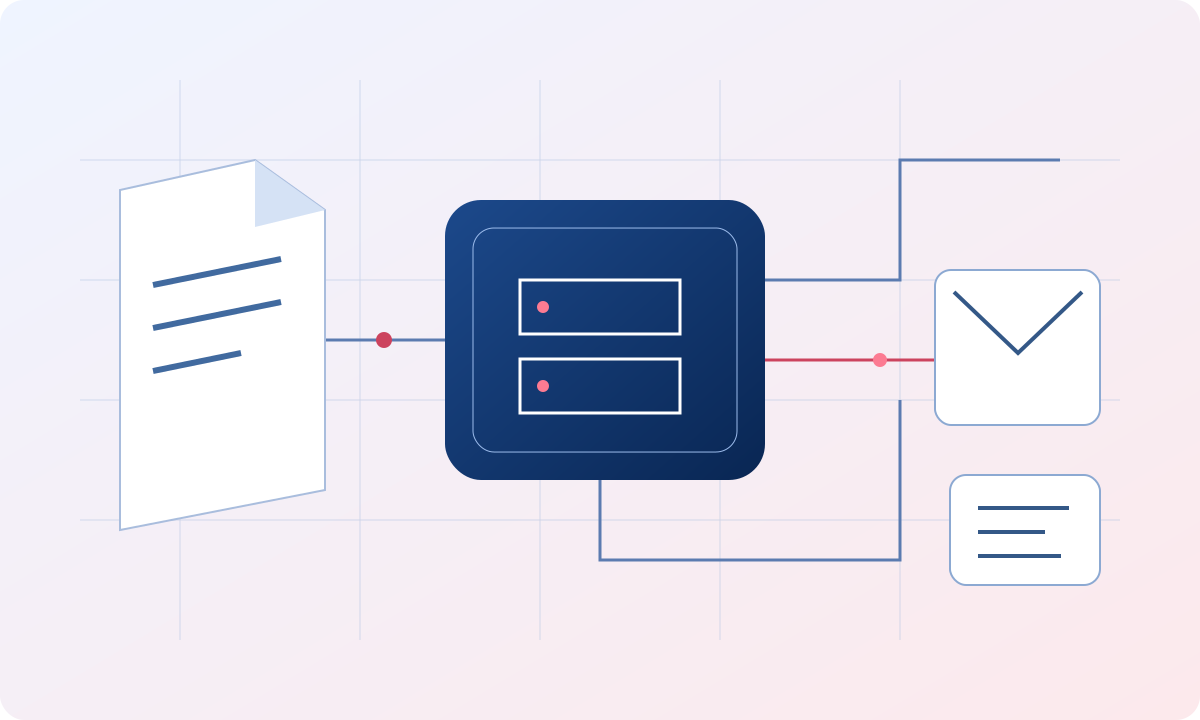
An invoice is a journey, not just a file.

Identify the information and format needed for your transaction.

Explanatory diagram: no live parliamentary tracking, security measurement or individual legal conclusion.
→

Your issuing deadline does not remove the need to check receipt now.

Sources and verificationOpen the sources +
Protect

The AI listening to your child: who sets the limits?

Protection is not just an access age. It also concerns the relationship an interface seeks to establish.

Areas of lawChild protectionArtificial intelligence
Keywords#KIDS Act#proposal#AI companion#privacy

Case statusSources consulted on 13 October 2026; proposals and timetables may change.

Original conceptual illustration prepared with AI assistance; no real event depicted.
Image and licence. Original conceptual illustration prepared with AI assistance; no real event depicted.

01

KIDS Act: a proposal to follow

The Commission describes the KIDS Act as a proposed regulation protecting minors online, not a ban already applicable to French families. It includes AI companions and conversational chatbots accessible to minors. [1]

Its explanation addresses interfaces simulating human relationships likely to create emotional dependency, alongside safeguards for conversation memory and activation of embedded chatbots. These are proposed measures: their wording and timetable must still be followed through the legislative process. [1]

02

Existing guidance, with a scope that matters

The July 2025 guidance on minors using online platforms addresses protective defaults, features encouraging excessive use and safeguards around integrated chatbots. It belongs to the DSA framework. [2]

These recommendations are non-binding and following them does not automatically guarantee compliance. Their scope must not be extended to every standalone chatbot without assessment. Protecting children also does not justify unlimited collection of their identity and confidences. [2,3]

03

Examine the experience, not only the terms

  1. Does the service clearly identify itself as a machine? Does it explain what is retained between sessions? Can notifications be stopped, the companion disabled and a troubling exchange reported?
  2. Schools, associations and publishers should test explanations accessible to young users and the route to an adult before recommending a tool. A marketing promise alone does not describe how a service behaves.
  3. Preserve an opportunity for human dialogue without demanding complete surveillance of confidences. These practical checks are neither a safety certification nor a medical diagnosis.
FRANCE · DECISIONS THAT MATTER · 03

Before sharing, take time to choose.

A child can ask a question without sharing their whole life.

Explanatory diagram: no live parliamentary tracking, security measurement or individual legal conclusion.
→

Technology for young people should help them grow, not make leaving harder.

Sources and verificationOpen the sources +

Simplex sigillum veri

Keep the ability to choose

This week, check one tax assumption, an invoice workflow or an AI companion’s limits. A precise question is worth more than a general assurance.

Research, drafting, translation, visuals and code prepared with AI assistance. Sources and limitations identified in each analysis. General information, not personalised legal advice.

Christophe Boeraeve

Law Right library

Return to every issue.

Each new issue expands the collection without replacing what came before.

Your network may not share an email address

Secure sign-in will become active once the app has been approved by the network. For this first issue, enter your email below. Your network choice is recorded only as the source; nothing is posted to your account.

LexiTalk to Lexi